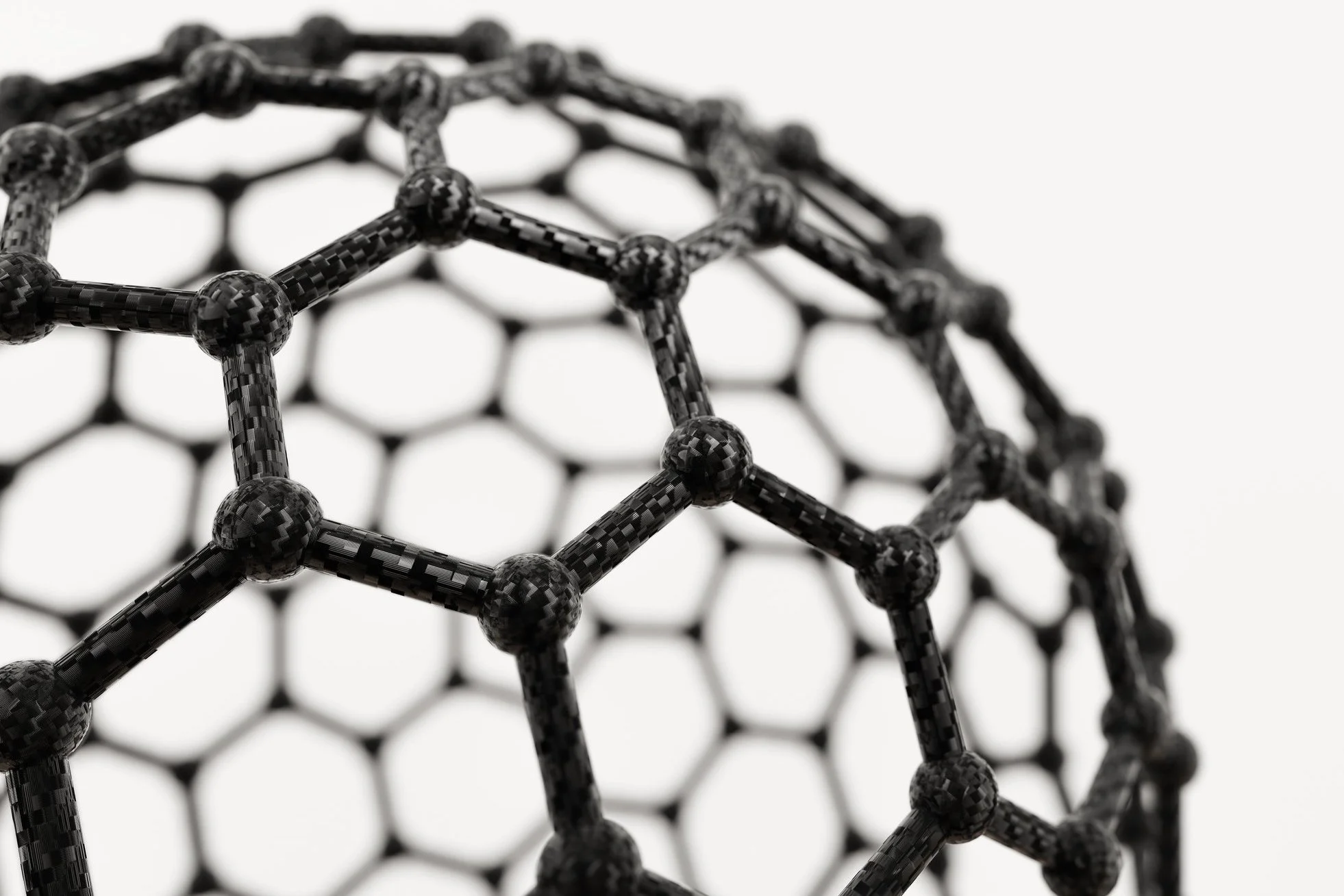
Fullerene Applications
Organic Photovoltaics Polymer Electronics Antioxidants & Biopharmaceuticals Additives & Other
Organic Photovoltaics (OPV)

Source: Janssen, et al, MRS Bulletin 1/2005
Currently, the record efficiency for a bulk heterojunction polymer solar cell is a fullerene/polymer blend. The fullerene acts as the n-type semiconductor (electron acceptor). The n-type is used in conjunction with a p-type polymer (electron donor), typically a polythiophene. They are blended and cast as the active layer to create what is known as a bulk heterojunction.

Source: Forrester, MRS Bulletin 1/2005
Fullerenes are used as is, or they are derivitized to increase their solubility. The most commonly used derivative in photovoltaics is C60, but C70 has been shown to have a 25% higher power conversion efficiency than C60 (Kroon et al, 6/2005). In addition, alternative derivatives such as C60 PCBB have been shown to increase conversion efficiency by over 40% when compared to C60 PCBM in like systems (Zheng, et al, 5/2004). In November of 2005, Gang Li et al published a record cell efficiency of 4.4% using a fullerene derivative manufactured by Nano-C, and illustrating the importance of the characteristics of the active layer on performance. As the preferred n-type material, fullerenes can comprise up to 75% of the active layer by weight. Solar cell efficiency continues to increase steadily, placing the potential for commercialization in the not-too-distant future.
Polymer Electronics
The performance of polymer transistors (Organic Field Effect Transistors (OFETS)) and photodetectors has also been increasing, in part due to a great deal of synergy between OFETS and OPVs. The leading OFETS use the n-type semiconducting properties of fullerenes based on C60, C70 along with C84. Fullerene OFETS fabricated with C84 show greater mobility than C60 or C70 and exhibit greater stability. While more work is needed, the world of polymer electronics is opening up for both fullerenes and single-walled carbon nanotubes.
Antioxidants & Biopharmaceuticals
Fullerenes are powerful antioxidants, reacting readily and at a high rate with free radicals, which are often the cause of cell damage or death. Fullerenes hold great promise in health and personal care applications where prevention of oxidative cell damage or death is desirable, as well as in non-physiological applications where oxidation and radical processes are destructive (food spoilage, plastics deterioration, metal corrosion).
Major pharmaceutical companies are exploring the use of fullerenes in controlling the neurological damage of such diseases as Alzheimer’s disease and Lou Gehrig's disease (ALS), which are a result of radical damage. Drugs for atherosclerosis, photodynamic therapy, and anti-viral agents are also in development.
Fullerenes are known to behave like a “radical sponge,” as they can sponge-up and neutralize 20 or more free radicals per fullerene molecule. They have shown performance 100 times more effective than current leading antioxidants such as Vitamin E. Recently, a new company, Zelens Dermatological Research, launched a skin care cream based on the C60 fullerene. This builds on the earlier launch of Vitamin C60 in Japan.

Nano-C has also conducted a limited series of screening tests for toxicity with a fullerene derivative formulated for lipid solubility. These preliminary tests for ocular tissue toxicity indicate no adverse effects. The picture to the left shows the high level of solubility in almond oil.
Additives & Other
Polymer Additives
Fullerenes and fullerenic black are chemically reactive and can be added to polymer structures to create new copolymers with specific physical and mechanical properties. They can also be added to make composites. Much work has been done on the use of fullerenes as polymer additives to modify physical properties and performance characteristics.
Other
| Catalysts |
|
| Water purification & bio-hazard protection |
|
| Portable power |
|
| Vehicles |
|
| Medical |
|

About Us
Fullerenes